E-invoices for household businesses in 2026: when they become mandatory

In this article
A household business in Vietnam with annual revenue of VND 1 billion or more must issue e-invoices, using one of two types: an e-invoice coded by the tax authority, or an e-invoice generated from a cash register that sends its data to the tax authority. When cumulative revenue reaches VND 1 billion, the household has 30 days to register. Below VND 1 billion it is optional, and you can register voluntarily if customers want invoices.
The threshold comes from Decree 68/2026/ND-CP as amended by Decree 141/2026/ND-CP (which raised it from VND 500 million to VND 1 billion from 1 January 2026), alongside Decree 70/2025/ND-CP on invoices. The wider picture is in household business tax in Vietnam 2026.
Why a foreign business owner should care
Two reasons. If you run a café or shop with a Vietnamese partner as the registered household owner, this is now part of your daily routine at the counter. And if you own a company, your household suppliers above VND 1 billion can now give you proper e-invoices, which you need to deduct the cost. A supplier who says “we’re a household, we can’t do invoices” may simply be behind on the 2026 rules.
The threshold and the 30 days
| Annual revenue | E-invoices |
|---|---|
| Under VND 1 billion | Optional; voluntary registration allowed |
| VND 1 billion or more | Required: tax-coded e-invoices, or e-invoices from a connected cash register |
| Under VND 1 billion, crosses it during the year | Register within 30 days |
The 30 days are currently described two ways. The Tax and Customs Review counts them “from the last day of the tax period” in which cumulative revenue reached VND 1 billion. VnEconomy counts them “from the moment cumulative revenue exceeds the threshold”. The two readings can be almost three months apart.
We use the earlier one: 30 days from the day the running total passes VND 1 billion. Registering early carries no penalty. Registering late might.
The two types, side by side
Tax-coded e-invoices. For each sale you create an invoice in your provider’s software; it goes to the tax authority for a code before the buyer receives it. Suits shops with fewer, larger sales, or that sell to companies needing the buyer’s name and tax code on the invoice.
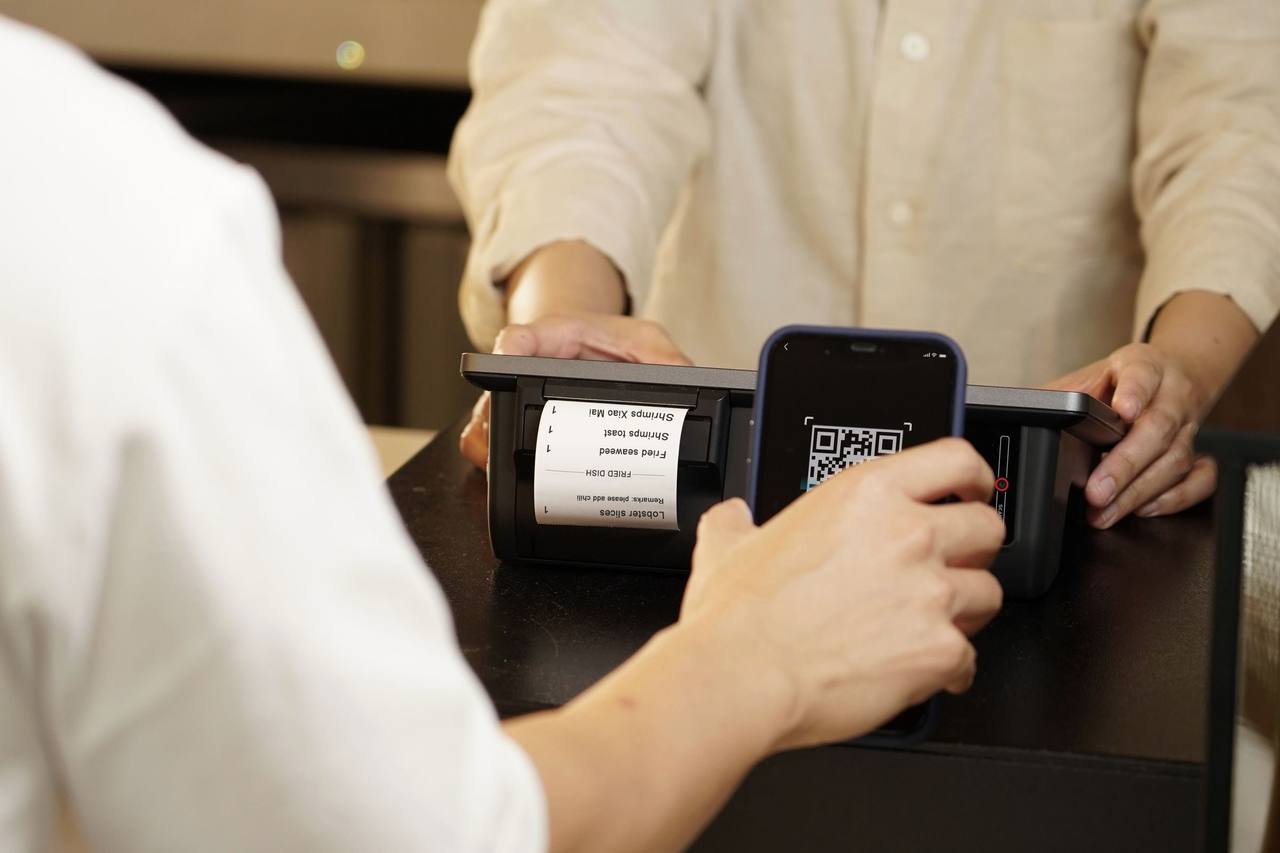
Cash-register e-invoices. The invoice prints at the counter from a cash register or POS software, and the data is sent to the tax authority. Suits shops with many small sales a day: eateries, cafés, grocery stalls, market stalls. Customers do not wait.
| Tax-coded | From cash register | |
|---|---|---|
| Best for | Few, larger sales; company buyers | Many small retail sales |
| Equipment | Computer or phone, online | Connected cash register or POS software |
| At the moment of sale | Create each invoice, wait for the code | Prints at the counter |
| Typical failure | Small cash sales never invoiced | Connection drops and data is not sent |
Some shops need both in practice: register sales at the counter, plus occasional wholesale orders for companies. Ask the provider whether their software can produce an invoice with full buyer details before you sign.
Three shops, three choices
Bến Thành market fabric shop, VND 2.4 billion. Required. Dozens of retail sales a day and occasional wholesale to tailors. It uses cash-register invoices linked to the POS software it already had. Each evening, the day’s invoice total becomes the line in its sales book.
Đa Kao bánh mì stall, about VND 620 million. Not required. But two nearby offices order every week and want invoices for their own accounts. Our advice: if the invoice customers are worth keeping, register voluntarily; if it is a few hundred thousand dong a week, there is no need yet.
A café that crosses VND 1 billion in October. It passes the line around 22 October 2026. On the earlier reading it registers before 21 November 2026, and with many small orders it chooses cash-register invoices. The other steps after crossing are in household businesses under VND 1 billion.
What it costs each year
Costs come in up to three parts depending on the provider: a set-up fee, an invoice package priced by volume, and for cash-register invoices any hardware or POS software you do not already have.
For reference, one HCMC service firm’s 2026 company setup price list puts an initial e-invoice package at about VND 850,000 to 1,550,000. That is for new companies; pricing for households and for cash-register invoices varies by provider. Ask for a full-year quote based on how many invoices you expect to issue, including next year’s renewal.
A café selling 150 drinks a day issues tens of thousands of invoices a year. A per-invoice package can cost more than an unlimited one. Count your daily sales before you choose.
Where people usually slip
- Waiting for the quarter to end. A café knows it crossed in October but plans to sort invoices out in the new year. On the earlier reading, it was already late by late November.
- Invoicing transfers but not cash. The shop registered its cash register but only prints invoices when customers pay by transfer. Invoiced revenue is lower than real revenue, and the return does not match the book.
- Buying too small a package. A 300-invoice package for a café doing several hundred orders a day lasts a day and a half.
- Return and invoices disagree. The tax office has your invoice data. Quarterly invoice totals have to match, or be explainable against, the revenue on return 01/CNKD.
- The invoice account in someone else’s name. The software seller or a friend registered the account for you, in their name. You find out you control nothing when you try to switch.
What we do in the tax filing package
Our tax filing service, VND 1.5 million a month before 8% VAT, tracks cumulative revenue and warns you before you reach the line, prepares the e-invoice registration in the owner’s name, reconciles invoice totals with the sales book every month and files the quarterly returns. You buy the software or cash register directly from the provider; we help compare quotes. See pricing, the 2026 tax calendar, or book a free 30-minute call.
Sources and update
Based on Decree 68/2026/ND-CP, Decree 141/2026/ND-CP of 29 April 2026 (VND 1 billion threshold, e-invoices for households from VND 1 billion, registration within 30 days) and Decree 70/2025/ND-CP on invoices. Sources currently describe the 30-day count differently; we will update once we have checked the original text. Invoice price reference from ACC Group’s published 2026 price list. Last checked 4 October 2026.
Sources checked
- Households with revenue from VND 1 billion a year must use e-invoices (Tax and Customs Review, 11 March 2026, Vietnamese)
- Households under VND 1 billion not yet required to use e-invoices (VnEconomy, Vietnamese)
- Decree 141/2026/ND-CP summary (MISA AMIS, Vietnamese)
- Company setup service in HCMC, cost table (ACC Group, Vietnamese)
Checked on 4 Oct 2026. Tax rules change often; ask an accountant about your own case before acting on this.
Written by
Lê Thu Trang, Household business accountant
Six years with fabric shops, eateries and phone stores. Leads moving households from lump-sum tax to self-declaration.